
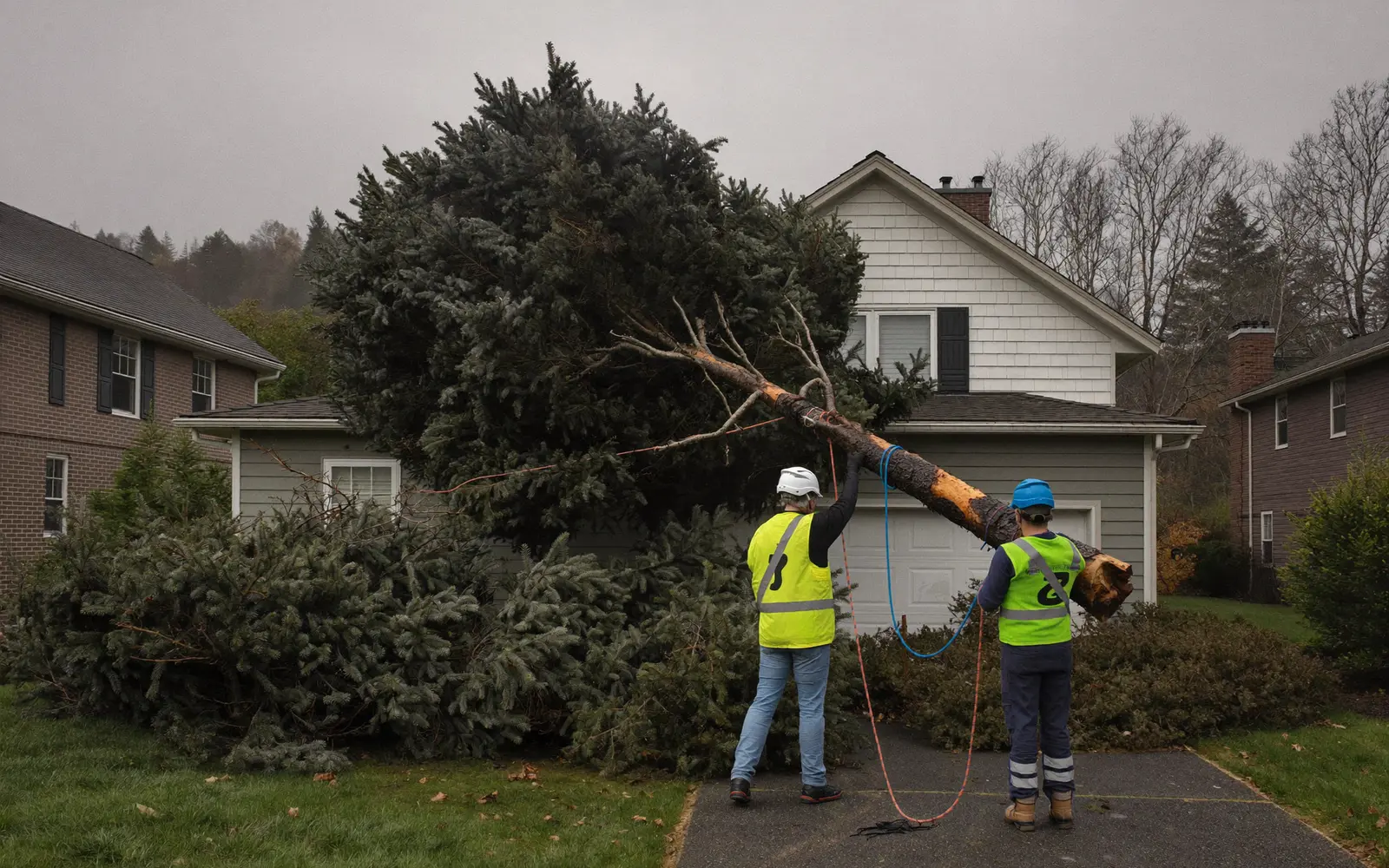
Redmond Summit Tree Service answers the same calls every windstorm: a fir through a roof, a maple across a driveway, a cedar leaning on the neighbour’s fence. Most of those trees showed warning signs weeks earlier. This page is the before-the-storm checklist for Redmond homeowners: what to look at, what Redmond lets you do about it, and what to set up so you’re not scrambling at 2 a.m. For damage that has already happened, see storm damage cleanup.
Why Redmond Trees Fail in Windstorms
Redmond’s storm risk comes from three things together:
- Tall conifers near houses. Douglas firs and western red cedars reach 100 to 150 feet, and many neighbourhoods were built around retained native trees.
- Saturated soil. After weeks of fall rain, roots lose their grip, and whole trees tip over at the root plate instead of snapping.
- Edge trees. Trees left standing at the edge of a cleared lot or new development grew up sheltered. Exposed to wind for the first time, they’re the most likely to blow over.
The November 19, 2024 bomb cyclone showed what that adds up to: gusts above 70 mph, two deaths in western Washington, and hundreds of thousands of Puget Sound Energy customers without power, with the Eastside hit hardest.
Your 30-Minute Pre-Storm Tree Check
Walk your yard in daylight, ideally in October. Look at every large tree that could reach your house, driveway, fence or a neighbour’s house if it fell (its full height in every direction).
| Look for | What it can mean | Urgency |
|---|---|---|
| Soil heaving or cracking at the base, roots lifting | The root plate is moving; the tree may already be failing | Call now |
| New or worsening lean toward a target | Root failure starting | Call now |
| Dead or brown top, bare branches in a conifer | Root disease or drought stress; dead wood breaks first | Soon |
| Mushrooms or conks on the trunk or roots | Internal decay (laminated root rot is common in Douglas fir) | Soon |
| Cracks, splits or a tight V-shaped fork | Structural weak point that opens in wind | Soon |
| Hanging or broken limbs from earlier storms | “Widowmakers” that drop in the next gust | Soon |
| Branches over the roof or touching service lines | Damage and outages in moderate wind | Before winter |
| Recently cleared land next to your trees | Edge trees newly exposed to wind | Have them assessed |
If anything in the first two rows applies, treat it as an emergency: see hazardous tree removal.
What Redmond Lets You Do Before a Storm
Redmond’s rules (RZC 21.72) give you three paths before the wind arrives:
- Pruning without removal. Removing dead wood, hanging limbs and weight from overextended branches generally doesn’t need a removal permit, as long as you don’t top the tree or cut so much that it’s effectively destroyed (heavy cuts can count as removal; ask the city if unsure). This is the cheapest risk reduction.
- Hazard Tree Declaration, no fee. A dead, dying, diseased or hazardous tree can be removed through a declaration backed by a certified arborist’s assessment (photos may be enough for an obviously dead tree). It doesn’t count toward your yearly removal limit.
- Emergency removal. Only for a tree that’s an immediate threat to people or structures: it can come down first, with the permit issued afterwards. Don’t use this path for a tree that’s merely worrying; start a declaration instead.
Full details: Redmond tree permits. In Redmond Ridge, Trilogy and Novelty Hill, King County rules apply instead: see King County tree rules.
Set Up These Alerts Now
| Alert | What you get | How |
|---|---|---|
| ALERT King County | Emergency alerts for your address, by text, email or call | Free sign-up at kingcounty.gov. Cell phones are not included automatically. |
| National Weather Service Seattle | Wind Advisories (gusts ~45–57 mph) and High Wind Warnings (58 mph+) | weather.gov/sew or any weather app with NWS alerts |
| Puget Sound Energy outage alerts | Outage and restoration texts for your address | Your PSE account or the PSE app |
When a High Wind Warning is issued: park cars away from big trees, stay out of rooms under the largest firs, and charge phones in case the power goes out.
Get Your Paperwork Ready for Insurance
If a tree does come down, claims go faster when you can show the tree’s condition before the storm:
- Photos of each large tree near the house (whole tree plus the base), dated, in October.
- Arborist notes or a report for any tree you were worried about. This also protects you if your tree damages a neighbour’s property.
- A record of any letter or email you sent a neighbour about their hazardous tree.
Homeowners insurance usually covers damage when a healthy tree falls in a storm. A tree that was visibly dead or neglected can shift the blame and the bill. Read your policy’s tree and debris removal limits now, not after the storm.
What to Do When a Tree Comes Down
- Stay at least 35 feet away from any downed line and call Puget Sound Energy at 1-888-225-5773 (or 911 if there’s fire or injury).
- Don’t cut limbs that are bent under tension, and don’t climb into damaged trees.
- Photograph everything before anything is moved.
- For trees on a house, a car or blocking access, call for emergency tree removal. We answer 24/7 during storm season.
Related Pages
Questions We Hear
When is windstorm season in Redmond?
Roughly October through March. The worst storms usually arrive November through January, when soils are already soaked from fall rain and big conifers still carry full crowns. The November 19, 2024 bomb cyclone hit the Eastside hardest of anywhere in the Puget Sound region.
Can I remove a risky tree before a storm without a permit?
Not without one, unless it's an immediate threat. In Redmond, a dead, dying or hazardous tree goes through a Hazard Tree Declaration, which has no fee. Only a tree that could fail at any moment can be removed first, with the permit issued afterwards. Starting the declaration in October beats waiting for a storm.
What wind speed knocks down trees around Seattle?
Damage starts at wind advisory levels: the National Weather Service issues advisories for lowland gusts around 45 to 57 mph, and High Wind Warnings at gusts of 58 mph or more. Saturated soil matters as much as speed: a 50 mph gust after a week of rain can uproot a fir that handled stronger winds in a dry month.
My neighbour's tree looks dangerous. What can I do before a storm?
Talk to them first, and put your concern in writing (an email with photos is enough). In Washington, an owner who knew or should have known a tree was hazardous can be liable if it falls. Never cut on their side of the line yourself: timber trespass under RCW 64.12.030 carries triple damages.