
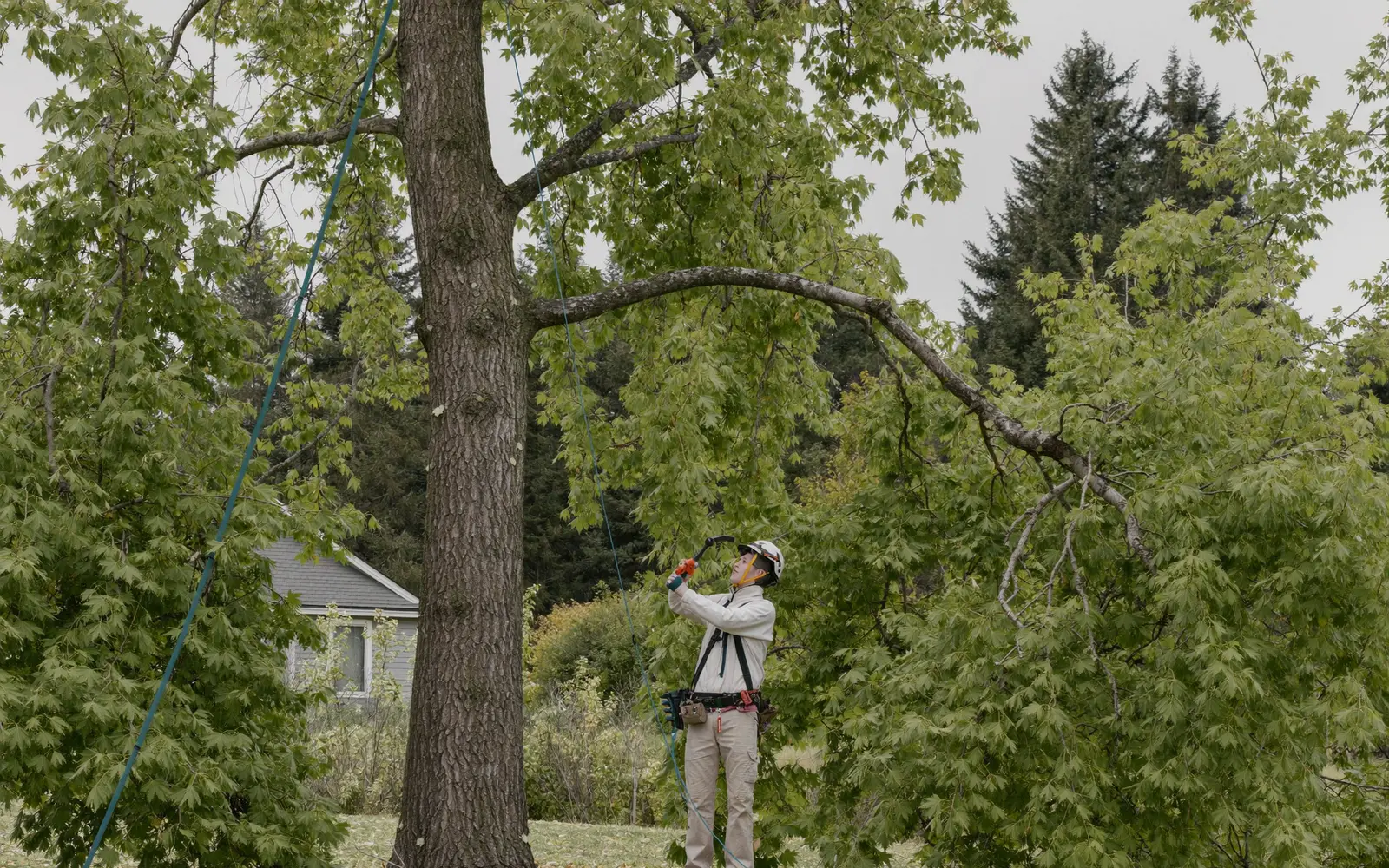
Redmond Summit Tree Service trims and prunes trees across Redmond, WA, to make them safer in wind, keep limbs off roofs and power lines, let light into yards, and keep trees healthy for decades. Good pruning is mostly invisible: the tree looks natural, just lighter and cleaner. Bad pruning (topping, lion-tailing, flush cuts) creates weak regrowth and decay that turns into a hazard a few years later.
Why Trim Trees in Redmond
Redmond’s tall conifers and big maples grew up in a wet climate and catch a lot of wind. Pruning reduces the load a storm can put on them:
- Storm safety. Removing dead wood and thinning dense crowns lets wind pass through instead of catching the canopy like a sail.
- Roof and gutter clearance. Fir and cedar limbs over roofs drop needles that clog gutters and hold moisture on shingles, which grows moss. Keep branches 6–10 feet off the roof.
- Light and lawns. Raising crowns (removing lower limbs) brings light back to lawns and gardens in shaded lots on Education Hill and in North Redmond.
- Tree health. Removing diseased, crossing and rubbing branches reduces entry points for decay.
- Views. Careful view pruning opens Lake Sammamish and Cascade views without topping.
Types of Pruning We Do
| Pruning type | What it is | Best for |
|---|---|---|
| Crown cleaning | Removing dead, dying, diseased and broken branches | Every mature tree, every few years |
| Crown thinning | Selectively removing live branches to reduce density | Big maples, dense cedars, wind exposure |
| Crown raising | Removing lower limbs for clearance | Driveways, lawns, sidewalks, views underneath |
| Crown reduction | Shortening limbs back to suitable laterals | Trees outgrowing their space (never topping) |
| Structural pruning | Shaping young trees to one strong leader | Trees under about 20 years old |
| Hedge trimming | Shaping laurel, Leyland cypress and arborvitae screens | Privacy hedges that have grown too tall or wide |
Why We Don’t Top Trees
Topping, which means cutting a tree’s top off to make it shorter, is the most common bad practice we see in Redmond. It feels like it makes a tall fir safer, but it does the opposite. The tree responds with a cluster of fast, weakly attached sprouts, and decay enters the large cut. Within 5–10 years you have a taller, bushier tree with a rotten top that’s more likely to fail in a storm. If a tree is genuinely too big for its spot, crown reduction or removal is the right answer.
Conifers vs. Deciduous Trees
Douglas fir, cedar and hemlock are pruned lightly: dead wood out, a few limbs thinned, lower limbs raised. Over-thinning a conifer exposes the remaining limbs and the trunk to wind they’ve never had to handle.
Bigleaf maple, red alder and ornamental trees handle more thinning. Maples especially benefit from reducing long, heavy horizontal limbs, which are the ones that break off in summer storms when the tree is in full leaf.
Hedge Trimming
Laurel, Leyland cypress and arborvitae hedges are everywhere in Redmond and grow fast. We trim them to shape, reduce height on screens that have got away from you, or remove them entirely when they’ve outgrown the yard. Hedges trimmed every year stay dense. Ones left for five years often need a hard reset.
What a Trimming Visit Looks Like
- Walk the property with you: which trees, what you want (clearance, light, safety, view).
- Look for problems you should know about, like decay, cracks or root issues.
- Written quote listing what will be cut on each tree.
- Climbers or a lift do the work; branches are lowered on ropes where they could damage roofs or gardens.
- Everything is chipped and hauled away, or left as mulch if you prefer.
Related Services in Redmond
Questions We Hear
What's the difference between tree trimming and tree pruning?
In everyday use they mean the same thing: cutting branches to improve a tree's safety, health or shape. Arborists sometimes use 'pruning' for structural and health cuts, and 'trimming' for shaping hedges and keeping branches clear of buildings. We do both, to ANSI A300 pruning standards.
When is the best time to trim trees in Redmond?
Late fall through late winter, while most trees are dormant, is ideal for structural pruning. It's easier to see the branch structure, and it gets trees ready before the worst windstorms. Dead or hazardous limbs should come off any time of year. Avoid heavy pruning of bigleaf maples in late winter, when they bleed sap.
How much does tree trimming cost in Redmond?
Most single-tree pruning jobs in Redmond run about $400–$900. Tall conifers that need a climber, crown thinning on large maples, or several trees in one visit can run higher. Small ornamentals and hedges are less. A site visit gets you an exact price.
Do I need a permit to trim a tree in Redmond?
Normal pruning doesn't need a Tree Removal Permit. But pruning so severe that it kills or effectively removes a significant tree (for example, topping a big fir) can be treated as removal. Trees in critical areas, such as stream and wetland buffers, have stricter limits.