
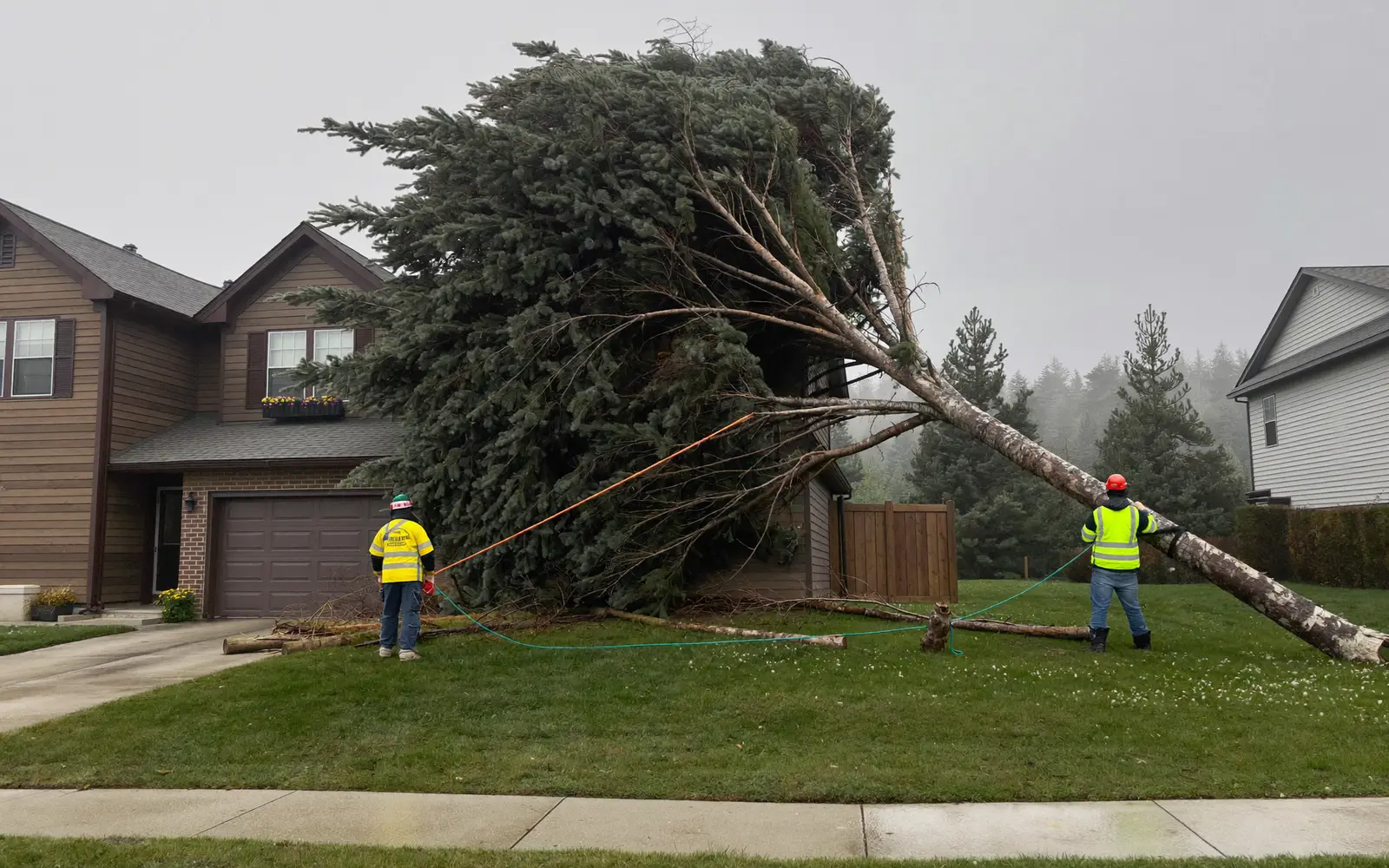
Redmond Summit Tree Service handles 24/7 emergency tree removal across Redmond, WA: trees on roofs, cars and fences, split trunks hanging over bedrooms, and uprooted firs blocking driveways after a windstorm. When a tree is threatening your home, you need someone who answers the phone, makes the scene safe, and removes the tree without causing more damage on the way down.
What Counts as a Tree Emergency
Not every fallen tree is an emergency, but these are:
- A tree or large limb on your house, garage or an occupied structure, especially if the roof is punctured or the tree is still moving.
- A leaning tree that has started to move. A new lean after a storm, cracking sounds, or soil and turf lifting on one side of the trunk all mean the root plate is failing.
- A split or hanging trunk over a house, deck, driveway or play area.
- A tree blocking your only way in or out, or blocking emergency vehicle access.
- Trees tangled in wires. Stay at least 35 feet away and call Puget Sound Energy first (1-888-225-5773). We can only start once the utility confirms the lines are safe.
If it’s a tree down in the yard with nothing underneath it, it’s urgent but not an emergency, and you’ll save money by booking it as a fallen tree removal during regular hours.
What Happens When You Call
- Triage on the phone. Where is the tree, what is it on, is anyone hurt, are wires involved? Send photos if you can. It tells us whether to bring a crane, a bucket truck or a climbing crew.
- Make it safe. First priority is stopping further damage: removing hanging sections, taking weight off the roof, and keeping people clear.
- Controlled removal. A tree lying on a roof is under tension. It’s cut in a specific order and lifted or rigged off, not dragged, so the roof structure isn’t damaged further.
- Clear access. Driveways and paths are cleared so you can come and go, and so roofers and restoration crews can work.
- Cleanup and documentation. Debris is hauled away or cut into rounds, and you get photos and an itemised invoice for your insurer.
Storm Damage We Handle
Redmond’s windstorm season runs from October to March. The 2006 Hanukkah Eve storm and the November 2024 bomb cyclone both brought down thousands of trees across the Eastside. The same patterns repeat every winter:
| Situation | What it usually needs |
|---|---|
| Douglas fir uprooted onto a roof | Crane or heavy rigging, sectional lift-off |
| Bigleaf maple limb through a deck or carport | Climbing crew, rope-down of sections |
| Cedar top snapped and hanging | Climber or bucket truck, controlled drop |
| Tree across a driveway or street | Ground crew, chainsaws, chipper |
| Tree on a fence between neighbours | Removal plus photos for both owners’ insurers |
Saturated winter soil is the main reason big conifers fail here. Douglas firs and hemlocks have relatively shallow root systems, and after weeks of rain a gust that a tree would normally survive can tip the whole root plate.
Working With Your Insurance
Most homeowners policies in Washington cover removing a tree that fell on a covered structure, minus the deductible, and often cap the debris-removal portion. Before anything is cut, if it’s safe:
- Photograph the tree, the damage and the base of the tree (root plate or break point).
- Call your insurer to open a claim, but don’t wait for an adjuster if the tree is still causing damage. Insurers expect you to prevent further loss.
- Keep the invoice and the photos we provide.
If the tree came from a neighbour’s property, their insurer may be involved, but in Washington it’s usually your own policy that pays for damage to your house.
Emergency Tree Removal Cost in Redmond
Emergency work costs more than scheduled work because of night and weekend hours, the need for cranes on short notice, and the slow, careful cutting a loaded tree requires. Typical Redmond ranges:
- Smaller tree off a fence, car or driveway: about $1,500–$3,000
- Large fir or cedar on a roof, rigging or crane: about $4,000–$10,000+
See the Redmond tree removal cost guide for what drives the price.
Permits After a Storm
The City of Redmond’s tree rules have a clear emergency exemption: when there is an imminent threat to the life and safety of people and structures, a tree can be removed without first getting a Tree Removal Permit, and the permit is issued retroactively. For trees that are damaged but not an immediate threat, such as a cracked fir that’s still standing, the right path is a Hazard Tree Declaration with a certified arborist’s assessment, which the city does not charge for. Details on our Redmond tree permit guide.
If you live in Redmond Ridge, Trilogy or Novelty Hill, you’re in unincorporated King County and different rules apply.
Related Services in Redmond
Questions We Hear
Do I need a permit for emergency tree removal in Redmond?
Not before the work. Redmond allows a tree to be removed without first obtaining a Tree Removal Permit when there is an imminent threat to the life and safety of people or structures. The permit is then issued retroactively. Take photos before and during removal. They support both the permit and your insurance claim.
How fast can you get to my house?
We prioritise trees on houses, blocked exits and anything touching power lines. During a big windstorm every crew on the Eastside is busy, so call as early as you can and send photos. That lets us triage and bring the right equipment the first time.
Will my insurance pay for emergency tree removal?
Usually, if the tree fell on a covered structure such as your house, garage or fence. Policies typically pay to remove the tree from the structure (often with a cap on debris removal) minus your deductible. A tree that fell in the yard without hitting anything is usually not covered. We document the job with photos and an itemised invoice for your adjuster.
What does emergency tree removal cost?
Emergency jobs usually start around $1,500 for a smaller tree off a fence or driveway and commonly run $4,000 or more when a large fir is on a roof and needs rigging or a crane. Night work, crane time and how tangled the tree is drive the price. You get the price before work starts unless there's an immediate safety step that can't wait.