
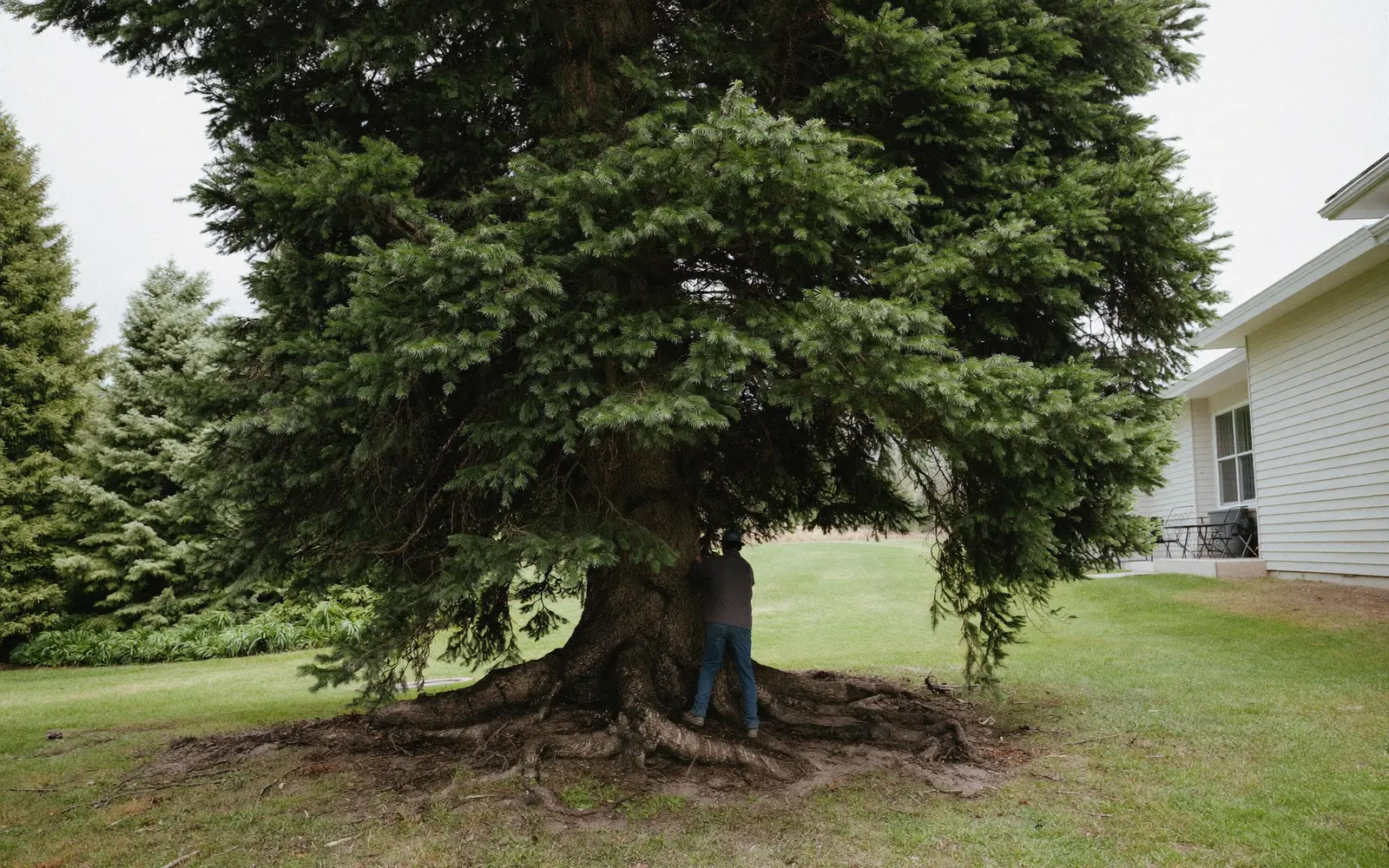
Redmond Summit Tree Service assesses and removes hazardous trees across Redmond: leaning firs, trees with root rot, cracked or split trunks, dead tops, and trees with large dead limbs over houses, driveways and play areas. A hazardous tree isn’t just a tree that’s big. It’s a tree with a defect that makes failure likely, and something valuable it would hit if it failed.
Warning Signs of a Hazardous Tree
| Sign | What it can mean |
|---|---|
| New or increasing lean | Root plate failing, especially if soil is cracked or lifted on one side |
| Mushrooms or conks at the base or on the trunk | Internal decay or root rot |
| Thinning, yellowing crown on a Douglas fir | Root disease such as laminated root rot |
| Vertical cracks or splits | Structural failure in progress |
| Dead top or large dead limbs | Brittle wood that drops without warning |
| Cavities and hollow sounds | Loss of sound wood in the trunk |
| Weak V-shaped fork with a crack | Co-dominant stems that can split apart |
| Recent construction near roots | Root damage from trenching, grading or new driveways |
Storm season coming? Walk through the pre-storm tree checklist first.
How a Hazard Assessment Works
An arborist looks at three things: the likelihood of failure (defects, decay, lean, root condition), the likelihood of impact (what’s in the fall zone and how often it’s occupied), and the consequences (a shed vs. a bedroom). Some trees can be made safe with pruning, weight reduction or cabling. Others need to come down. For formal documentation, see arborist reports.
Removing a Hazardous Tree in Redmond
The city treats hazardous trees differently from healthy ones:
- Hazard Tree Declaration: a form plus a tree health assessment completed by a certified arborist, reviewed by the city before removal. No fee.
- Photos may be enough for a tree that is obviously dead, dying or diseased. Consult the city before submitting to see if your situation qualifies.
- Imminent danger: if the tree threatens people or structures right now, it can be removed first under the emergency rule, with the permit issued afterwards.
- Critical areas: hazardous trees in wetlands, stream buffers or Native Growth Protection Areas need an arborist’s mitigation recommendation, and the wood generally stays on site.
Full details in our Redmond tree permit guide.
Common Hazard Trees in Redmond
- Douglas firs with root rot. Laminated root rot spreads tree to tree underground. Infected firs can blow over with an intact-looking crown.
- Cedars with dieback. Browning tops on western red cedars after dry summers. Dead tops become brittle.
- Bigleaf maples with weak forks. Multi-stem maples splitting at the base.
- Red alders past maturity. Alders are short-lived. Older ones along creeks and greenbelts decay from the inside.
- Edge trees. Firs that grew in a forest and are now exposed after neighbouring lots were cleared.
Safe Removal
Hazard trees are removed with extra caution: less load on the tree, more use of cranes and bucket trucks instead of heavy climbing, and careful planning of the drop zone.
Related Services in Redmond
Questions We Hear
What is a Hazard Tree Declaration in Redmond?
It's the city's form for removing a tree that's hazardous. You submit it with a tree health assessment from a certified arborist, and the city reviews it before removal. There's no fee for hazard tree declarations, unlike regular removal permits. For a tree that's obviously dead, dying or diseased, city staff may accept photos instead of a full arborist report, so ask the city before submitting.
Does a hazardous tree count against my yearly removal limit?
The yearly limits (2–8 trees depending on lot size) apply to healthy significant trees. Hazard trees go through the hazard declaration path instead. Ask the city how it treats your specific case.
My neighbour's tree looks dangerous. What can I do?
Talk to your neighbour first and share specific concerns, like the lean, cracks or mushrooms at the base. A written arborist assessment carries weight. Don't cut a neighbour's tree yourself: Washington's timber trespass law (RCW 64.12.030) can make you liable for up to triple damages.