
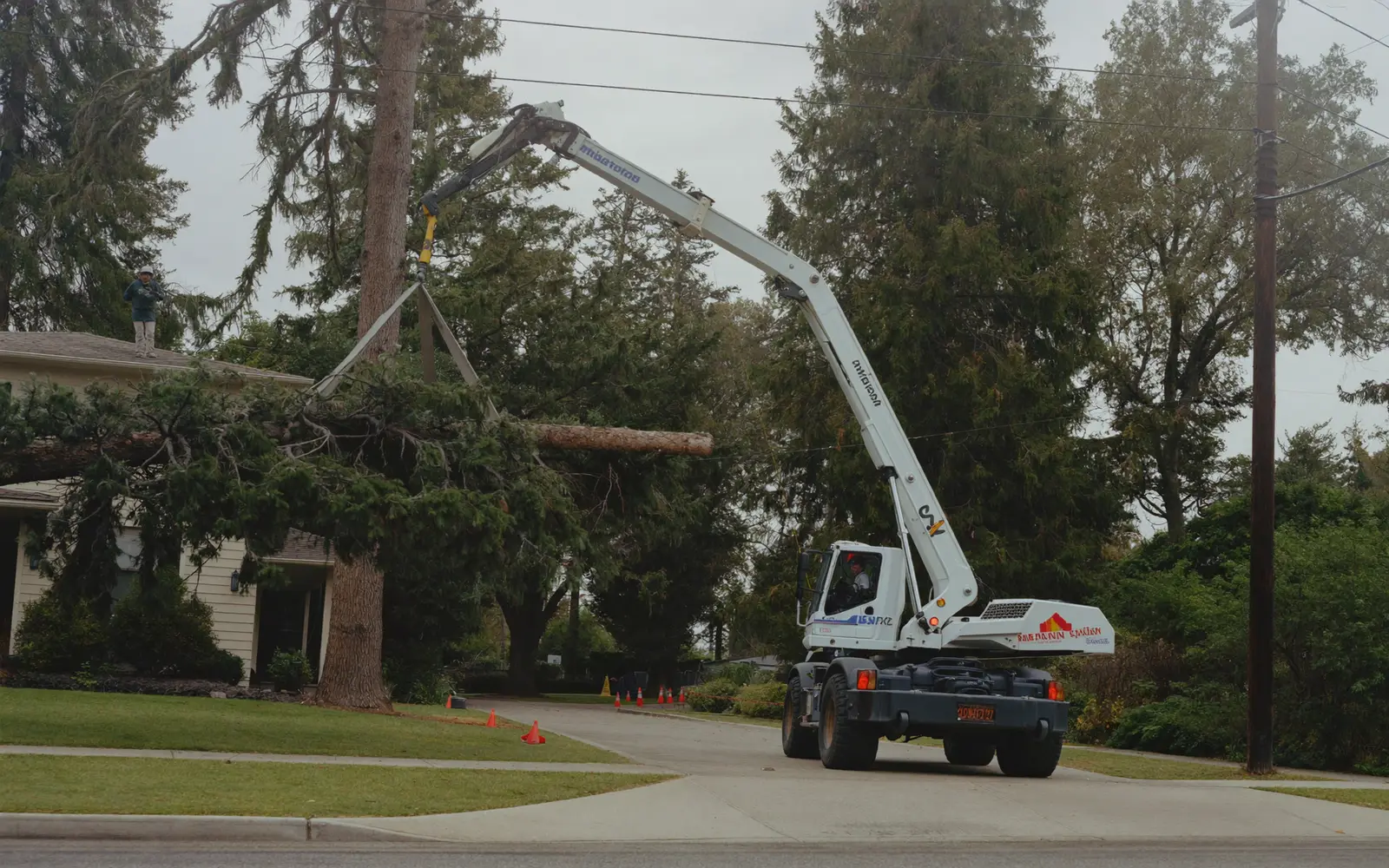
Redmond Summit Tree Service uses crane-assisted removal for the Redmond trees that can’t be safely felled or rigged: big Douglas firs leaning over roofs, trees in fenced backyards with no drop zone, decayed or storm-damaged trees too risky to climb heavily, and trees hanging over neighbours’ houses. The crane holds each section of the tree before it’s cut, then lifts it over the house to the street, where it’s chipped or cut up.
When a Crane Is the Right Call
- No drop zone. Backyard trees surrounded by the house, fences, sheds and gardens.
- Leaning over a structure. The crane takes the weight so nothing swings or drops toward the roof.
- Decay or storm damage. Trees with rot, cracks or snapped tops that aren’t safe to load with a climber and rigging.
- Very large trees. Firs with trunks over 3–4 feet in diameter, where each rigged section would be too heavy for ropes.
- Speed. A crane can finish in hours what rigging takes a day or more, which means less time with a crew on your property.
How Crane Removal Works
- Site plan. Where the crane sets up, its reach and lift capacity at that distance, where the sections land, and traffic control if it’s in the street.
- Rigging point. A climber goes up and attaches the crane’s sling above the cut.
- Cut and pick. The climber cuts; the crane already holds the weight and lifts the section clear.
- Land and process. Sections are set down in the street or driveway, then chipped or bucked into rounds.
- Repeat until the trunk is down to a stump, which can then be ground out.
Crane vs. Rigging
| Rigging (ropes) | Crane | |
|---|---|---|
| Best for | Medium trees, some drop space | Large, leaning, decayed, no drop zone |
| Load on the tree | High: the tree holds the rigging | Low: the crane holds the weight |
| Time on site | Often a full day or more | Often a few hours |
| Cost | Lower equipment cost | Crane time added, less labour |
| Street impact | Minimal | Crane in the street, may need traffic control |
Crane Removal After Storms
After a windstorm, a fir lying on a roof is still loaded with tension. Cutting it the wrong way can drop the weight further into the house. With a crane holding the tree, each section is cut free and lifted straight off. That’s why most trees-on-houses emergency calls involving large conifers use a crane.
Permits
Crane jobs follow the same tree rules as any removal: a Redmond Tree Removal Permit for significant trees (6” diameter and up), a Tree Exception Request for landmark trees over 30”, or a Hazard Tree Declaration for hazardous trees. If the crane needs the public street, a separate right-of-way use permit may be required. See the Redmond permit guide.
Related Services in Redmond
Questions We Hear
Is crane tree removal more expensive?
Per hour, yes: the crane and operator add cost. But a crane can take down in a few hours a tree that would take a crew a full day to rig, so on large, awkward trees the total is often similar, and sometimes cheaper. For decayed or storm-damaged trees, a crane is often the only safe option.
Where does the crane set up?
Usually in the street or driveway. Crane reach depends on its size: a typical tree-service crane can lift sections from a backyard over a house. If it has to set up in a public street, traffic control and a right-of-way permit from the City of Redmond may be needed; we handle that as part of planning.
Will the crane damage my driveway or lawn?
The crane's outriggers sit on pads that spread the load. Asphalt and concrete driveways are generally fine. Lawns get mats. Sections are lifted over the house, never dragged across the yard.